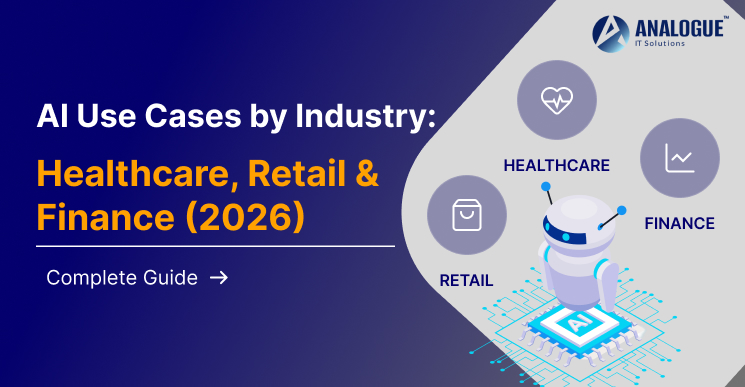
Why AI Is Becoming Essential for Businesses in 2026
AI is no longer limited to large enterprises. Thanks to cloud computing, machine learning platforms, and generative AI tools, businesses of all sizes can integrate AI into their daily operations.
The primary benefits of AI include:
● Increased operational efficiency
● improved customer satisfaction
● reduced manual workloads
● predictive analytics
● enhanced cybersecurity
● personalized customer experiences
● and lower operational costs
Organizations adopting AI today are better prepared for future market demands and digital transformation.
AI Use Cases in Healthcare
The healthcare industry continues to experience one of the fastest AI adoption rates due to increasing patient volumes and the demand for more accurate diagnoses.
1. AI-Powered Medical Diagnosis
● Earlier disease detection
● Improved diagnostic accuracy
● Reduced human error
● Faster treatment decisions
2. Predictive Patient Care
● Predicting heart attacks
● Detecting sepsis early
● Monitoring chronic diseases
● Identifying high-risk patients
3. Virtual Health Assistants
● Scheduling appointments
● Answering medical questions
● Sending medication reminders
● Managing follow-up care
4. Drug Discovery
● Research costs
● Clinical trial timelines
● Drug development risks
AI Use Cases in Retail
Retail businesses are leveraging AI to improve customer engagement, optimize inventory management, and increase sales.
Personalized Product Recommendations
● Higher conversion rates
● Increased average order value
● Better customer retention
● Personalized shopping experiences
2. Intelligent Inventory Management
● Avoid stock shortages
● Reduce overstock inventory
● Improve warehouse efficiency
● Optimize supply chain operations
AI-Powered Customer Support
● Order tracking
● Product recommendations
● Return processing
● FAQs
● Complaint resolution
Visual Search Technology
AI helps retailers improve customer satisfaction while optimizing business operations.
AI Use Cases in Finance
Financial institutions have been early adopters of AI because accuracy, security, and speed are critical in the banking sector.
1. Fraud Detection
● Reduced financial losses
● Faster fraud prevention
● Improved customer trust
● Enhanced security
2. Credit Risk Assessment
● Spending behavior
● Income stability
● Transaction history
● Debt obligations
3. Robo-Advisors
● Financial goals
● Risk tolerance
● Investment horizon
● Market conditions
4. Intelligent Financial Forecasting
● Cash flow
● Revenue
● Market trends
● nvestment opportunities
● Customer behavior
Businesses can make faster and more informed financial decisions using predictive analytics.
Common AI Technologies Driving These Industries
Several AI technologies power these real-world applications:
Machine Learning (ML) -
Learns from historical data to continuously improve predictions and decision-making.
Natural Language Processing (NLP) -
Enables chatbots, voice assistants, customer support automation, and language understanding.
Computer Vision -
Allows AI to recognize medical images, objects, facial recognition, and visual data.
Predictive Analytics -
Uses historical data to forecast future business outcomes and trends.
Generative AI -
Creates content, automates documentation, generates reports, supports customer service, and improves productivity.
Benefits of AI Across Industries
Businesses implementing AI solutions experience measurable improvements, including:
● Faster decision-making
● increased automation
● higher operational efficiency
● better customer experiences
● improved accuracy
● reduced costs
● stronger cybersecurity
● greater scalability
● enhanced productivity
As AI technology continues to evolve, organizations that invest early will be better positioned for long-term success.
Future Trends of AI in 2026
Several emerging AI trends are expected to shape the future of healthcare, retail, and finance:
● Hyper-personalized customer experiences
● Autonomous AI agents handling complex workflows
● AI-powered cybersecurity systems
● Voice-enabled business automation
● Edge AI for real-time processing
● Explainable AI (XAI) for transparent decision-making
● Responsible AI with stronger governance and compliance
● Industry-specific AI copilots for employees
These advancements will further improve efficiency, innovation, and customer satisfaction.
Conclusion
Artificial Intelligence is no longer just a technological innovation it is a strategic driver of business transformation. In 2026, healthcare organizations are improving patient care through predictive diagnostics, retailers are delivering personalized shopping experiences, and financial institutions are enhancing security with AI-driven fraud detection.
As AI continues to mature, businesses that adopt intelligent automation, machine learning, and data-driven decision-making will gain a significant competitive advantage. Whether you're a startup or an enterprise, investing in AI solutions today can help streamline operations, improve customer experiences, and prepare your organization for the future of digital transformation.



 For Business :