Understanding Custom App Development
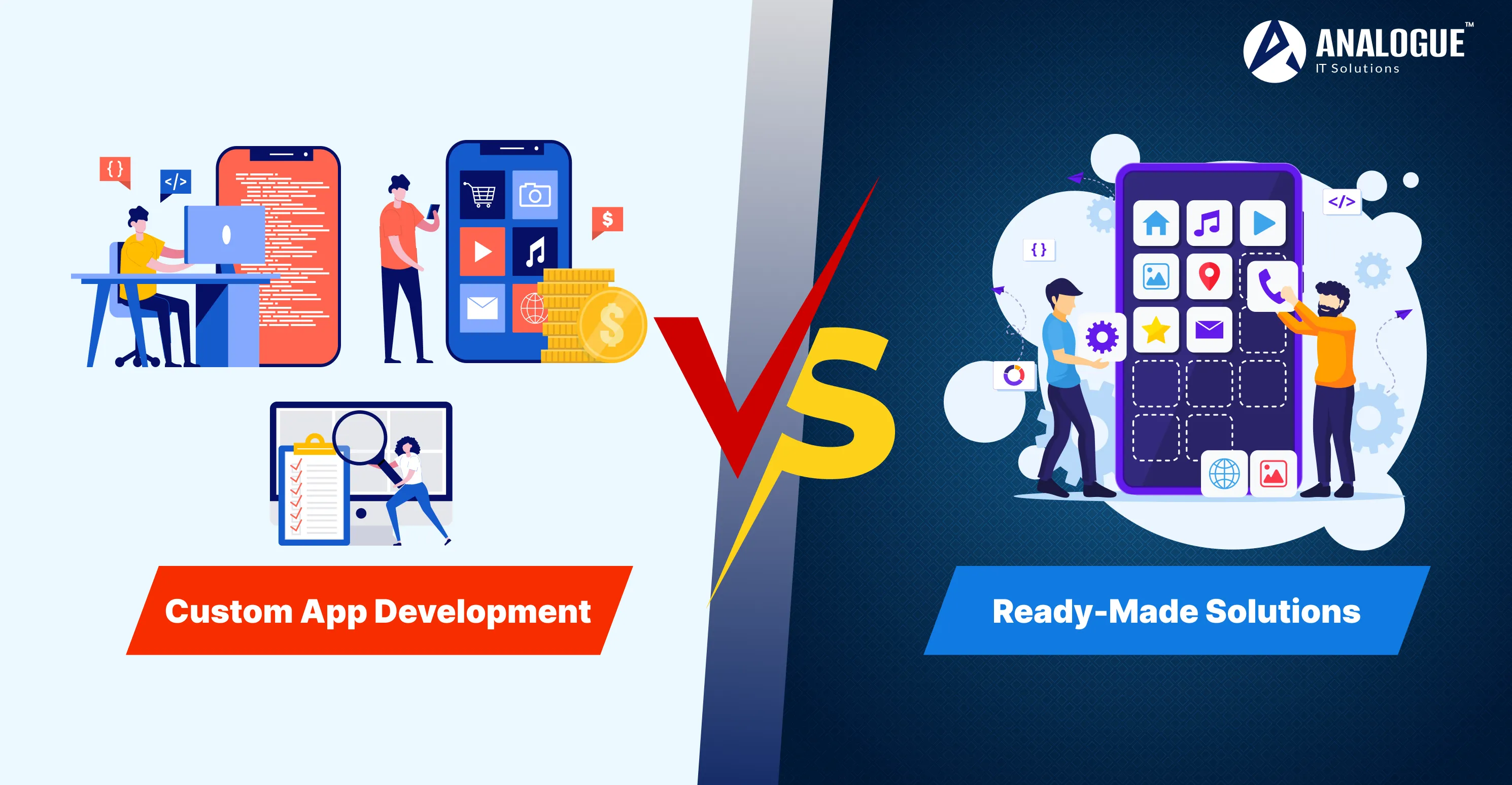
Custom app development refers to building an application specifically tailored to your business needs. Everything inside the app from the user interface to workflows, backend logic, and integrations is created to match how your business actually works. Instead of adjusting your processes to fit the app, the app is designed to fit your processes. Custom apps are usually preferred by businesses that need unique features, industry-specific workflows, higher security, and a brand-centric user experience. Since the solution is built exclusively for you, it gives you full ownership and control over how the app functions and evolves over time.
Understanding Ready-Made App Solutions
Ready-made or off-the-shelf applications are pre-built software products created for general business needs. These apps are designed so that many companies can use the same product with minimal configuration. You simply purchase a license or subscribe to a plan, set up your account, and start using the app. These solutions are popular among businesses that want something quick and affordable. However, customization is usually limited, and businesses often need to adjust their working style to match how the software has been designed.
Factors You Need to Consider Before Choosing an App Solution
| Factor | Custom App Development | Ready-Made Solutions |
|---|
| Development Time | Longer | Quick to deploy |
| Cost | Higher upfront | Lower initial |
| Ownership | Full ownership | Subscription-based |
| Scalability | Highly scalable | Limited |
| Security | Custom security | Standard |
| Customization | Fully flexible | Restricted |
| Maintenance | Developer-managed | Vendor-managed |
Why Businesses Choose Custom App Development
Businesses that opt for custom app development usually do so because they want a solution that completely aligns with their goals. Custom apps provide the advantage of tailored workflows, better user experience, and seamless integration with existing systems. They are also more secure because security mechanisms can be built specifically for the type of data your business handles. Another key benefit is scalability. As your company grows, your app can evolve with it. New functionalities can be added, performance can be optimized, and architecture can be designed to support large-scale operations. This makes custom development an excellent long-term investment for businesses that are planning for growth.
Benefits of Custom App Development
1. Built Around Your Business Needs
● Tailored workflows
● Personalized UI/UX
● Custom integrations
● Business-specific automation
● This creates a better user experience and operational efficiency.
2. High Scalability
● As your business grows, your app grows with you. You can:
● Add new modules
● Expand capabilities
● Handle larger user bases
● This makes custom apps ideal for startups planning to scale.
3. Strong Security
● Custom apps allow:
● Advanced encryption
● Role-based access
● Secure databases
● Compliance-based features
● This is critical for industries like healthcare, fintech, and enterprise applications.
4. Competitive Advantage
● Since the app is unique, competitors can’t simply copy your processes.
Limitations of Custom Apps
● Higher initial investment
● Longer development timelines
● Requires skilled developers
● Ongoing maintenance cost
● However, the long-term return on investment is often higher.
While powerful, custom apps do have challenges:
Why Some Businesses Prefer Ready-Made Solutions
Ready-made apps are often chosen by startups or small businesses that need software quickly and do not have complex requirements. Since the product is already developed, the cost is significantly lower initially compared to a custom-built application. The vendor also handles maintenance, updates, bug fixes, and hosting, reducing the technical burden on the business. However, as the company grows, limitations start appearing. Many businesses eventually find that the software cannot fully support their operations, forcing them to either purchase expensive upgrades or completely migrate to a custom solution later.
Benefits of Ready-Made App Solutions
1. Lower Initial Cost - You only pay for:
● Subscription plans
● Licenses
● Basic add-ons
● This makes ready-made apps suitable for small businesses or early-stage startups.
2. Faster Deployment
● You can be up and running in days or weeks - not months.
3. Maintenance Included - The vendor handles:
● Updates
● Bug fixes
● Security patches
Limitations of Ready-Made Solutions
This is where most businesses start facing issues:
● Restricted customization
● Feature limitations
● Vendor lock-in
● Shared security infrastructure
● Scalability constraints
● Monthly subscription dependency
Eventually, many businesses outgrow these platforms and move to custom development.
Which Option Works Best for Startups?
For startups testing a new idea or entering the market with limited funds, a ready-made solution or a basic MVP may make sense initially. It allows them to validate their concept quickly. But when the startup begins to scale, custom app development becomes far more valuable because it supports growth, innovation, and brand differentiation.
Which Option Suits Established Businesses?
Established businesses benefit more from custom app development because they already have defined processes and long-term strategies. They need security, reliability, data control, and flexibility all of which are easier to achieve with a custom-built application.
Final Thoughts: Which Is Better?
There is no universal right answer. The best choice depends on your budget, business stage, complexity of requirements, security needs, and long-term goals. Ready-made apps are ideal when you need something quick, affordable, and basic. Custom app development is the better choice when you value control, scalability, brand identity, and future-ready technology. Many businesses actually start with ready-made software and later switch to a custom application once they realize the importance of flexibility and ownership. The key is to evaluate not only what you need today, but also where you want your business to be in the future.


 For Business :